Friday, September 25, 2015

[It's the Interns] Our lives can’t be isolated from our obligations

It is always hard to say good bye!
Advancing Justice-Atlanta Summer Internship has come to a close. "it's the Interns" series continue with our interns who worked behind and in front of the scene to Build Power for Good in the South and their thoughts on the Internship.

By Brian Lee


·    What was your most memorable moment from the internship?

The most memorable moment from my internship was when I was given the opportunity to speak at the Pan Asian Action Network Meeting in front of a large group of community leaders about the advantages of receiving citizenship. While getting caught up in the moment and thinking of the upcoming election, I accidentally suggested that one could run for president if they were a citizen (which only applies if one is natural born). It served as a lesson in humility to prove that no matter how much experience I may have from debate or mock trial, I can still make obvious mistakes. (I also happened to be embarrassed.) 

·    What was an eye-opening, unexpected experience, challenges, or knowledge gained from the internship?

As a person who tends to micromanage, I learned more about social dynamics within a nonprofit setting and teamwork in general. Being able to observe and work with everyone from Helen to other talented interns allowed me to better understand how trusting associates delegate and execute various tasks allows for a more efficient system of collaboration. Though fundamental, I think that my firsthand experience gave me a unique perspective into the process that I would not have been able to see had I chosen to work in larger corporate setting. 

·    Why do you believe it is important to be involved in Civic Engagement?

I believe it is important to be involved in civic engagement because our lives can’t be isolated from our obligations. Almost everything that we do, from throwing our trash in the appropriate disposal container to posting about our thoughts on social media, are basic expressions of our political position. To guarantee the right to do these things requires that our positions are recognized by the people living around us, thus highlighting the significance of engagement.
Even when the issues don’t affect how we live our daily lives, we still have the altruistic obligation to help those that are marginalized or oppressed. It is unacceptable to allow transgressions to occur while we stand by

·    How do you hope to incorporate what you have learned this summer as you go forward?

 Because I intend on pursuing a career in law and politics, much of the information that I learned will be applicable in my life; however, in the near future I feel that the practical skills utilized around the office will help me organize my schedule and workspace. Furthermore, I plan on staying involved in civic engagement campaigns with Advancing Justice going forward, so I hope to be of further service to the community with my newly developed skills.

·    What advice do you have for the future interns?

 My advice for future interns is to keep an open mind and try not to let personal biases shape the learning experience that is provided by the internship. As an individual with strong stances on particular issues, I felt that this might have limited me from grasping all of the opportunities provided, but I think that knowing this going forward will guarantee a great experience for new interns.

·    What unique skill set did you developed from the internship?

Over the past three years, I’ve learned the entire process of canvassing starting from the door to data input in the Voter Activation Network, administrative skills involving Microsoft Office and event organization, as well as citizenship and voter registration procedures. Though it may not be a singular unique skill, I believe that these tasks helped me to develop my versatility, allowing me to redirect a few of my capabilities into a wider range of assignments. 

· What was the best Asian dish you had throughout the internship?

It was a bit sweet, but I really enjoyed eating pad thai.

·    Why are you proud to work with the immigrant community?

The immigrant community is made up of the most hard-working, diligent, and entrepreneurial individuals who risk everything for family and a brighter future. I couldn’t be more proud to work with these people who value improving society over their own immediate needs and desires, and it is my honor to be a part of this group.


Wednesday, September 16, 2015

[It's the Interns] People can change, people can still make change, and political apathy can be broken

It is always hard to say good bye!
Advancing Justice-Atlanta Summer Internship has come to a close. "it's the Interns" series continue with our interns who worked behind and in front of the scene to Build Power for Good in the South and their thoughts on the Internship.

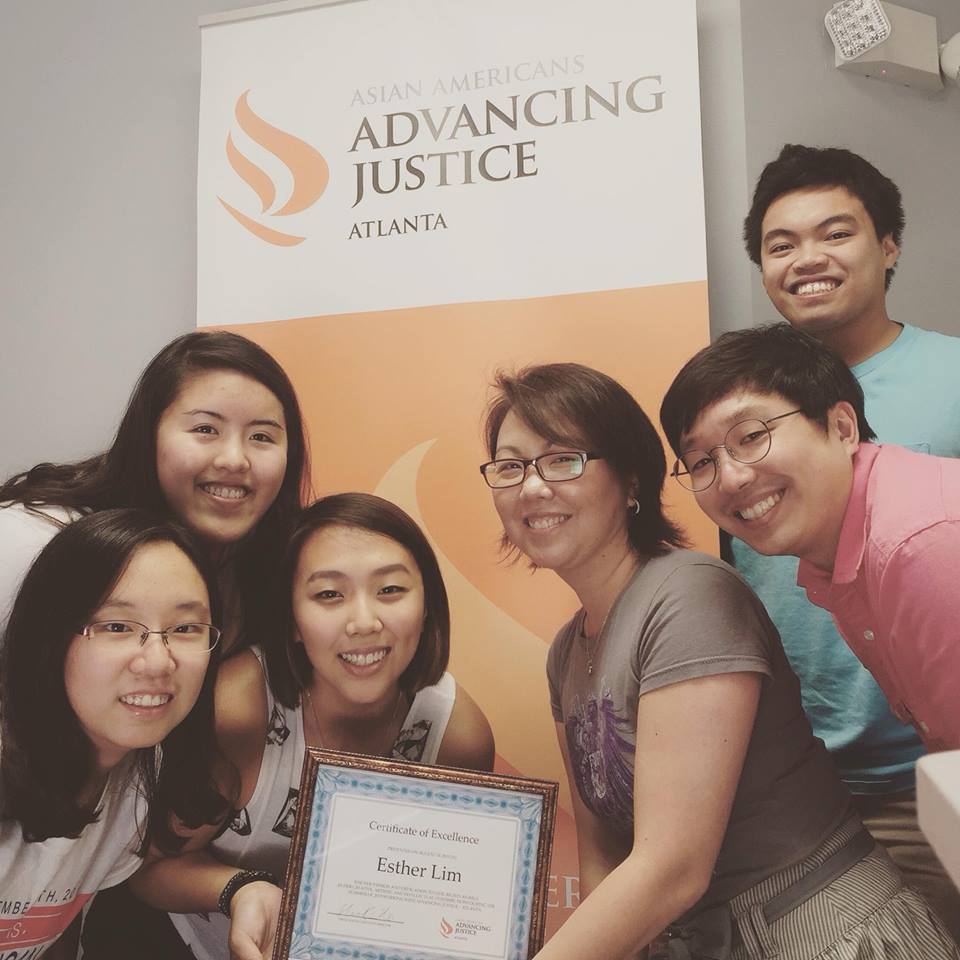
By Esther Lim


·    What was your most memorable moment from the internship?

There wasn’t a single moment that stood out so much as there was a handful that made me more hopeful that positive change could and would eventually occur. My line of study can be disheartening when looking toward the future, so I most valued the moments in which I was given reason to believe that people can change, people can still make change, and political apathy can be broken. 

·    What was an eye-opening, unexpected experience, challenges, or knowledge gained from the internship?

I’m a part of a generation of voters and political activists who have lost faith in the legitimate power of presidential elections and of other ‘democratic’ processes, so recognizing that my vote has such weight in non-presidential elections was empowering to say in the least. In addition, I had always believed that to affect change, I’d have to climb my way into the upper echelons of American politics, but working here over the summer, I realized positive change could occur much more easily than I’d assumed. It’s simply a matter of getting people to care, to participate, to vote, and ultimately, to understand how much power they actually have.

·    Why do you believe it is important to be involved in Civic Engagement?

I think it’s important for a whole host of reasons that vary depending on who you are and what goals you’re trying to achieve. For me personally, civic engagement was and is most important because it dissolves what I describe as my activists’ paralysis - the paralyzing fear or premature exhaustion that sets in when thinking about what needs to be done or changed. It allows me to recognize that, though we may not be bringing about immigration law reform or stomping out systemic racism as immediately as I would like, my community and I are taking necessary steps toward these end goals. 

·    How do you hope to incorporate what you have learned this summer as you go forward?

I hope to use what I’ve learned this summer to beat off the negativity and sense of political nihilism that can sink in when circumstances seem bleak.

·    What advice do you have for the future interns?

If you intend to go into this field, use this internship as an opportunity to learn how you interact and deal with the work you’re doing, the people you work with, and the spaces you’re in. Working toward human equality can be emotionally and mentally tasking, so it’s good to figure out asap how you can cope.

·    What unique skill set did you developed from the internship?

The internship definitely helped me refine my graphic design skills as well as my legislative research & write up skills. Aside from that, however, I learned a lot about civic engagement - mainly how to plan and execute effective campaigns, programs, etc.

· What was the best Asian dish you had throughout the internship?

Perhaps not the best, but the most memorable and the most meaningful: Samosas, particularly those from Sri Krishna Vilas. 

·    Why are you proud to work with the immigrant community?

Most simply, because it’s the community my family belongs to and it’s a community I’m proud to be part of. More specifically, because the immigrants I know and work with have fought harder to survive and thrive than most people I’ve known, despite seemingly endless social and legal obstacles. Being part of an immigrant community fueled and informed my passion for social equality and human rights. The better question would be: Why wouldn’t I be proud to work with the immigrant community?


Thursday, August 20, 2015

Dosan Ahn Chang-Ho places his foot step on the International Civil Rights Walk of Fame

By: Claire Shin & Leslie Wang


One hundred and thirteen years after Dosan Ahn Chang-Ho set his first step onto the American soil, his footprint was now permanently honored as a part of the International Civil Rights Walk of Fame, located at the Martin Luther King Jr. Center, Atlanta, GA. It was also an appropriate time to celebrate his accomplishment and legacy as Korea celebrates 70 year anniversary of its Independence from Japan. 

On August 13, Asian Americans Advancing Justice-Atlanta was invited to the unveiling of Dosan Ahn Chang-Ho’s footprints which now resides with those of many other Civil Rights activists, such as Rosa Parks and Congressman John Lewis at the International Civil Righst Walk of Fame at the Martin Luther King Jr. National Historic Site.

Born in 1878, Ahn Chang-Ho was an Korean independence activist who entertained and set out to exercise clear reforms to education and the modernization of schools in Korea, two of the most important efforts dedicated by Ahn Chang-Ho. Also known as Dosan (도산)- his pen name- Ahn Chang-Ho was respected as a patriotic figure who fearlessly fought for democracy and independence to prevent Korea from being obliterated by Japanese imperialists.

Since he was young, Dosan, with the ultimate goal of reforming and modernizing the nation of Korea, studied Western Education and became a great leader and educator. To seek better education, Dosan and his wife arrived in the United States in 1902, which made them the first married Korean couple to set foot on the Mainland. To advocate for his mission, Dosan circumnavigated the globe, starting in America in 1902 and going on to travel across Asia, Russia and Europe to return successfully to New York in 1911, making him the first Korean to go all around the world. During his immigration into the U.S., Dosan managed to establish the Friendship Society in 1903 and Mutual Assistance Society in 1905 to reform the local Korean community in San Francisco, California by establishing the Young Korean Academy in San Francisco in 1913.

Leaving behind his legacy to the Korean people in America, Dosan returned to Korea through China in 1926 to protest out of love for his country and his people. Irritated by Dosan’s anti-Japanese and patriotic activism, Japanese imperialists arrested and tortured him multiple times during his imprisonment. Dosan never came back to America. He was released on bail by Japanese authorities and died in a the Kyungsung University hospital on March 10, 1938 after he lived an honorable life. Many scholars believe that, had he lived beyond Korea’s liberation in 1945, Korea would not be divided.


The induction of Dosan Ahn Chang-Ho was a recognition of his beliefs and work. We wished someday there would be more people who could interpret his legacy in a more global context and understand his contribution to the advancement of civil rights. 


Friday, August 14, 2015

Visit to Stewart Detention Center

By Claire Shin & Linghan Wang


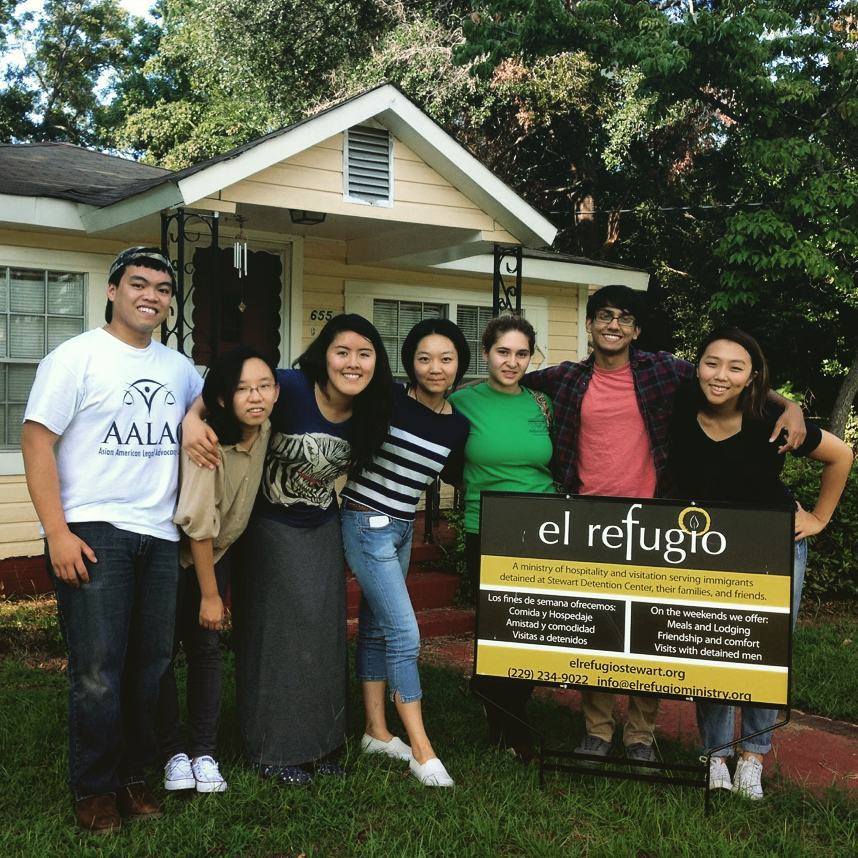
Advancing Justice-Atlanta staff and Interns visited Stewart Detention Center, located in Lumpkin, GA, a three-hour drive from Atlanta. Operated under the Corrections Corporation of America-a company that owns and manages private prisons and detention centers. The Center is a corporate-run and for-profit facility, currently detaining approximately 1,700 men. The Center only holds males, whose families, if they lived or traveled with them, were separated from them and sent to other detention facilities.

The staffs and interns arrived at Lumpkin, GA around noon. We were welcomed by El Refugio, a hospitality house serving family members who came to visit their loved ones in Stewart Detention Center. Anton Flores-Maisonet, one of the volunteers there, introduced to us the history and the situation of Stewart Detention Center whilst giving us instructions of how to communicate with the inmates.

Each one of us was paired up with a detainee who had written request letters for visitors. The detainees spoke different languages, including Spanish, Bengali, Arabic, Nepalese, Hindi, Chinese, etc. After a long wait at the visitors’ area, we were eventually able to meet with our friends in the detention center. Several of the detainees had never had any visitors before us; separated by a plexiglass wall we could only talk with them through a telephone set on each side of the partition.

From the conversations we had, we learned that many of the detainees fled their countries in fear of political persecution or police brutality. They came to the U.S. with families and friends and turned themselves in at the U.S. border to seek asylum. However, upon detainment they were placed in Stewart and became separated from their families, who were detained in other detention centers. Other detainees were people who outstayed their visas or undocumented immigrants who were arrested by law enforcement for minor offenses, such as running a red light. Detainees stay in the facility for long periods of time that ranges from several months to two years or more, though 93% of them are eventually deported.

People spend the one-hour recreational time on working within the facility for $1 to $4 payment per day. They wash laundry, clean, work at the supermarket, etc. Each detainee has only one hour of visitation time each week, during which they are allowed to meet with their families and friends. For this reason, many families came to Stewart Detention Center on Saturday we visited to see their loved ones. They would then stay over at El Refugio in order to have another visit on Sunday.

Currently, there are Spanish, Chinese, Korean and Nepali speakers in the detention center. Our group got to know them as they wrote request letters for visitors, from which Anton assigned us a friend to speak to in the Center. There might be other language speakers who had not done so due to language barriers and other reasons.

The people at Stewart Detention Center appreciate visitations and friends to speak to, and El Refugio depends entirely on volunteers. If you are interested in visiting the detention center or helping out at El Refugio, visit El Refugio’s website at http://elrefugiostewart.org/ for more information. It was a meaningful experience for us to become aware of the system of detaining immigrants for profit as well as to learn about the experiences of the detainees there.

Check back with us as we will share more stories from the visit to the Stewart Detention Center.


Wednesday, August 5, 2015

A Conversation About Being Asian-American in the South with Film Maker Matthew Hashiguchi


By Saisha Mediratta


When asked to reflect on the Asian-American experience in the South, several things immediately come to mind. I think back to the days of smelly lunches, people asking me if I understood English, and the constant feeling of being different. However when Matt Hashiguchi, an award winning documentary film maker, came and visited us here at Advancing Justice on July 21, 2015, we had to dig a little deeper, and recall a little further of what makes the Asian American experience in the south different from anywhere else. Matt primarily focuses on cultural and ethnic stories, motivated by his own half-Japanese, half-Italian background and the experiences he faced because of that, so the questions felt more like a conversation than an interview.

The staff and we interns eased into this topic smoothly because it is definitely something we have all thought about. Esther and Claire provided a unique perspective because although they grew up in the South, they have been attending college in the North for the past couple years. In their experience, the racism, discrimination, and dual feeling was equally as prevalent in the North as in the South even if it takes different forms. Language and accents became a source of discussion because every single one of us here had seen or faced such a situation such as being asked whether we need help, speak English, or our parents being asked to repeat something or being treated poorly.

Matt was constantly stressing on how any of this was any different than the North, and it wasn’t until another staff member joined the discussion did we really hit on what makes the South unique. She pointed out that the Asian American community in the South is not as well established as the North; the Advancing Justice branches in the North and on the West Coast are proof of that very observation because they are over a decade older than the Atlanta branch. She additionally mentioned that the legacy of racism in the South dates all the way back to the Civil War, so the historical context with which people view racism in the South is very black and white vs somewhere like California because of incidents like the Japanese internment camps during WWII.

Matt was especially interested in the concept of an “in between” feeling many Asian-Americans talk about, the sense of never truly fitting into either culture. Leslie, an international student from China, provided the apt contrast to all of our in between experiences because she said she has always considered herself just Chinese, not Asian or Asian-American. Esther and I recalled experiences at our heavily Asian populated school of never being part of a group, distancing ourselves from the Asian American community, or doing the complete opposite and isolating ourselves to just our community. Raymond’s experiences of growing up in Macon, Georgia, a predominately white neighborhood, really spoke to this topic because he really wasn’t exposed to the Asian American community until later in his life. He struggled with being open about his Filipino heritage in public in addition to his immigration status. Matt was fascinated with Raymond’s story, DACA, and his political awareness about the situation in Georgia and other states in the South.

The discussion forced all of us to introspect on the emotional impact of being an Asian-American particularly in the South and relive specific experiences. Matt was looking for a subject, a unique experience in the South, and although he didn’t quite get exactly that, our discussion definitely pointed him in a direction whether that be the lack of race discussion, the “in between” experience, or even the newer establishment. Either way, our conversation proved to be a learning experience for all of us, and helped us find common ground with each other no matter what our nationality.


Check out Matt’s work at his website: http://www.matthewhashiguchi.com/

Wednesday, July 29, 2015

Review of The Fence


By Claire Shin & Linghan Wang


On Thursday, July 16, we watched an HBO documentary called The Fence. On October 2006, President Bush signed the Secure Fence Act of 2006 that started a project to build a fence hundreds of miles along the US-Mexico border. According to the documentary, the project utilized 12 designs, hired 19 construction companies, 350 engineers and more than 7,000 construction workers.


So what project was this exactly? Was it an economic stimulus plan that created new jobs through construction of the fence? Aside from any economic function that the construction might serve, the fence was primarily built with the goal to prevent terrorism, drug smuggling and illegal immigration from entering into the United States from the US-Mexico border.


Quoted during the documentary, President Kennedy once proudly said, “we [had] yet to build a wall” to impede free human migration within and across the United States and other countries; now the US government decided to build a wall due to concerns that immigrants that crossed the border illegally posed a threat to the national security.


However, the fence project was not properly equipped with the technical capacity to perform the designated function. The U.S. government had spent 30 years at Lower Rio Grande Valley National Wildlife Refuge building an inhabitable and vital living space for wildlife animals. Despite reiterating several times that it would try its best to protect wildlife, the U.S. government ate its words by building the fence right through the refuge, separating many animals from their sources of food and water.

It was unsurprising that damages were incurred not just to animals. During the rainy season, a portion of the fence in Arizona became a virtual dam that withheld water on the Mexican side and impeded the water flow into U.S. territory. With 20 feet of water drowning the town, compared to only 6 inches on the U.S. side, many family businesses were destroyed or forced to relocate to other areas.

Compared to the insurmountable costs of construction of the fence, was it adequately executing the task of preventing terrorism, narcotics or illegal immigration? In actuality, the government might be aiming at a false target. Of the 29 people who committed terrorist acts in the United States in the last quarter of century, 24 arrived through plane and 5 were born on native soil. Sadly the fence was unable to effectively prevent either drug smuggling or illegal immigration, as the criminal groups were always able to find new ways to respond to the barriers positioned to stop them.

On August 8, the staff and interns will be visiting Stewart Detention Center at Lumpkin, GA, where many undocumented immigrants and many people who overstayed their visas are detained. We will be able to meet the detainees in person and might also be able to provide them with language assistance. Many Mexicans attempted to cross the border into this country carrying the hope for better living conditions and more optimal occupational opportunities. Though many have lived in the detention center for years, each and every one of them deserved proper human dignity as a birthright, and Asian American Advancing Justice -Atlanta is determined to help them preserve that right.

Monday, July 27, 2015

[It's the Interns] Meet Yao Sun

It is time to meet our AMAZING Interns!
Advancing Justice-Atlanta Interns are here and "It's the Interns" series goes in-depth about who is working behind and in front of the scene to Build Power for Good in the South!


·    Hello! Tell us little about yourself

Hi, my name is Yao, and I am from Qingdao, China. I came to the United States for college three years ago. Now I am a rising senior student at Emory University. My major is international studies with a focus on Asia and economic policy. I have been taking part in nonprofit organizations since freshman year and I love the experience of working with enthusiastic people.

·    What made you decide to apply for this internship?

At first, I met the staff from Asian Americans Advancing Justice at a career fair held in Emory University. I was very impressed by the works of AAAJ. Later, I learned more about the organization, which has been dedicated to make changes for Asian American community. I would love to be part of that and to help promote better life and unite Asian Americans to demand social equality and political rights.

·    What is your expectation and what would you like to get out of the internship experience?

I expect to learn a lot from this internship, and I have been doing so. I volunteered at several events that AAAJ held before I got this internship. For example, I participated in the fourth Annual Asian American Legislative Breakfast and Lobby Day, which gave me life experience with governmental officials and leaders from various groups. When advertising new immigration laws to Burmese immigrants, I learnt a lot about the latest immigrant policies and its relation to the federal legislation process. As this internship goes on, I expect to keep learning about related public policies, laws, regulations, problems, and difficulties Asian American community is facing.

·    Tell us your personal narrative on being Asian in America

Growing up in China, I felt the difference of being an Asian for the first time when I came to the United States. Looking from the experiences of many of my friends and my own, I think that Asians in the U.S. is not only the minority ethnic group but also the unheard. I recognize my identity as being an Asian and I feel that the voice of Asians continues to diminish if they do not demand social justice, political power, and legal rights for themselves.

·    What role would you like to play in Asian American Community in the future?

I would like to help better the social and political statues of Asian American Community. Also, I want to provide information and knowledge to those who do not have access to them. To do so, I have to equip myself with the knowledge and skills needed, and I expect to gain more knowledge and improve my skills from this internship.

·    What is your song of the year?

I am not so sure about my song of the year, but I am very fond of Ella Fitzgerald recently.

·    Any Last words???

I am excited to be on board and I saw everyone busy working and enthusiastic about what they were doing on the first day of my internship. I hope to be part of that.